The New Mystērion
This weekend I was at a dinner party with the theme “The AI Bubble.” A brilliant conceit: an evening structured around a single conversation topic; perfectly in keeping with the kind of generative thinking that always comes from my dear friend, who recently lectured at MIT on the future of technology. The dining room and living room were filled with minds moving easily between literature, quantum computing, and art: a constellation of thought floating there several storeys above Central Park West.
It was after the cheese plate had been sufficiently foraged, and several bottles of wine opened, that our host declared we were living in a new age of mysteries. And with my own longstanding adoration for the iconography of humankind; the long, unbroken trail of evidence left by those who spent centuries probing the unknown; I felt any residual discomfort about living through the current paradigm shift evaporate. The neural rewiring, the acceleration of it all momentarily dissolved as I tried to articulate my sense that the geometric and theoretical discoveries emerging from AI and computation will, in time, reflect the structure of the human mind. Then, in turn, the mind will begin to reflect the architectures born from these systems. Ultimately, it is all an effort to see, however faintly, the underlying makeup of the universe. I view it geometrically as such in my minds-eye.
It was then, in this shared contemplation, that our host invoked the smallest of particles through mime. He held out his forefinger and thumb, pinching the air as he spoke. Those microscopic building blocks studied precisely because their largest-scale analogues evade our perception. Their enormity renders them invisible; their presence, though vast, cannot register. As he spoke, I imagined an immense sphere before us, so large it appears only as a flat, eternal plane. A wall. A horizon. A mystery.
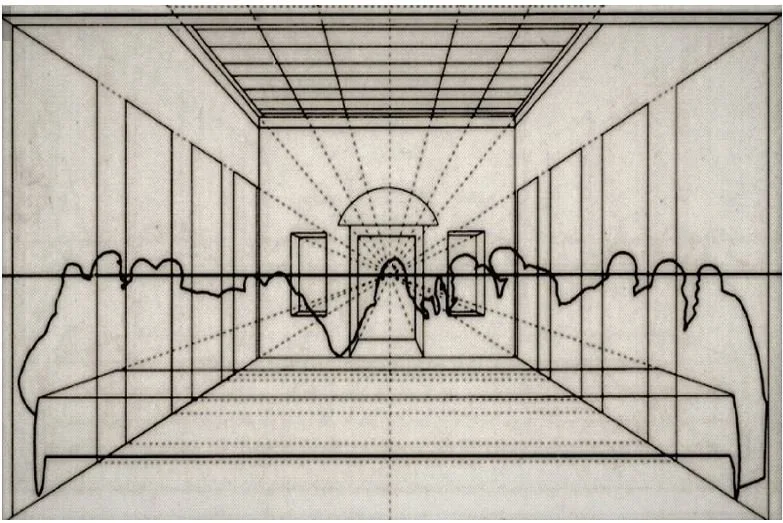
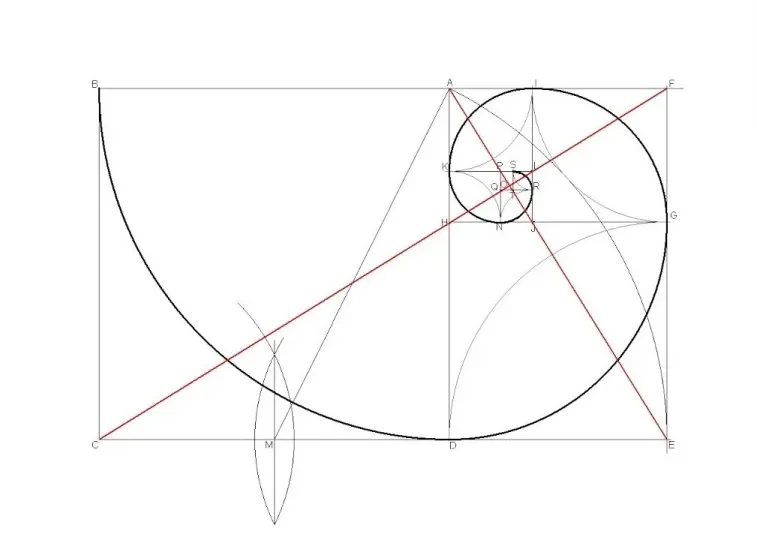
In the classical era, science, art, and philosophy were not separate disciplines but strands of a single inquiry. The Greeks searched not only for the mechanics of nature but for the meaning embedded in it. Art mirrored this quest for order: the contrapposto stance, the golden ratio, the idea that beauty itself might be a form of truth. To sculpt the human body in marble was to reveal how nature thought.
The Renaissance is often described as a rebirth, but it was also a resurfacing of awe. When Leonardo da Vinci dissected cadavers and sketched the inner machinery of the body, he was not merely drawing: he was decoding. His notebooks, filled with vortices, flying machines, and ideal proportions, read like transmissions from a mind trying to catch up with a universe accelerating ahead of him.
Kepler would later speak of the “harmony of the world,” convinced that planetary orbits were, in essence, musical intervals. It was in that same vein of thought that I found myself speaking at length with a graduate of one of the finest music institutions about his work in quantum research.
Newton, who I can think on endlessly, with his apple and his relentless calculus, collapsed the heavens and the earth into the same physical laws, pulling back a cosmic curtain.
And with the Industrial Revolution, by the time Einstein arrived, reality itself had begun to deform. Time stretched. Space curved. Mass became energy. The universe was no longer a static stage but an elastic medium, responsive and relational.
Quantum mechanics shattered Newton’s rule. And with that too, came cubism, surrealism, futurism… Duchamp's "Nude Descending A Staircase" in perpetual superposition. Visions of the world multi-dimensional - - as deconstructed planes, and dreamlike.
Now, in the early twenty-first century, the rhythm of discovery has sped up again, to the point where understanding feels perpetually out of reach. Every day I wake up to news of great change. AI and Quantum transforming to be more expansive and powerful with each rising sun. Lifting the veil. We are surrounded by systems that think in ways we do not yet fully grasp. I marvel daily at the work of Google DeepMind, Palantir, IBM, NVIDIA…
Breakthroughs in mathematics and cognition no longer require centuries. They unfold in weeks, sometimes hours. The models we build begin to surprise us; the algorithms we design generate insights we never programmed. AI has become the new telescope not pointing outward at the stars, but inward at the patterns of thought itself, but it is there, too, where the cosmos reside.
When the Pythagoreans gazed at the heavens, they saw order hidden in chaos. When da Vinci sketched the turbulence of water, he saw law in the wild. When Einstein wrote E=mc2, he saw unity in the unimaginable.
We are entering a moment where cognition, computation, and physics begin to blur as they did in the ancient world. Where discovery feels mythic.
Gen Beta is not the age of answers; it is the “Age of New Mysteries”, as the host declared with such disarming wonder. Even in the darkness and the sense of impending unraveling, there is a renaissance of awe that mirrors the mystery of the universe itself.
I cannot help but imagine hundreds, even thousands of years from now, considering what will survive and what stories might be told. Future generations will speak of this evolution at their own proverbial dinner parties, remembering it as a time that was, whether for good or evil, profound.