Before The Law
Ellen Courtney
“Vor dem Gesetz” (read here)
Kafka’s short parable written alongside his (in my opinion) greatest novel, The Trial, arises from the juridical consciousness he developed through his legal education and professional life. His years within the bureaucratic structures of early twentieth-century Austro-Hungarian administration gave him firsthand insight into law as both abstract principle and lived system. Scholars note that Kafka’s fiction persistently interrogates the law not merely as a set of rules, but as an opaque structure of authority, and exclusion. Without this experience, we might never have been graced with the term Kafkaesque. It is a word that now signifies the fusion of rational order with existential paralysis.
Franz Kafka studied law at Charles University in Prague, where he earned his Doctor of Law degree after a course of study that combined civil, and criminal law with legal philosophy. After completing his degree, he worked for the Workers’ Accident Insurance Institute, a government agency where he investigated industrial injuries and drafted legal reports. The job weighed heavily on him; he described it as exhausting and soul-numbing. Unable to abandon his work, Kafka wrote late into the night, transforming his legal insight into literature that exposed the absurdities of modern authority. Largely unknown throughout his life, The Trial and Before The Law, were not published until after his death in 1925. But with their release into the world, it became evident that his legal background is largely what informed the structure and tone of his writing.
In Before the Law, the man from the country approaching the gate embodies the paradox of legal modernity: access to the law is theoretically universal, yet in practice, it is indefinitely deferred by institutional authority. The gate remains open, but entry is denied; a contradiction that exposes Kafka’s fascination with the law’s promise of justice and its simultaneous refusal to deliver it.
Critics have long observed how Kafka entwines existential alienation with authoritative absurdity. In The Trial, and again in this parable, law and justice appear as dysfunctional systems that demand obedience while concealing their mysterious logic: “This entrance was made only for you… now I am going to shut it,” captures the tension between singularity and universality: sense and nonsense, as the slow system robs those in it of their lives (and sanity).
Kafkaesque
Law is Kafkaesque not simply because Kafka wrote about it, but because it embodies the very paradoxes that haunted his imagination. It is a system designed to serve and protect, yet it often alienates those who seek its help. Formally, law presents itself as rational, and accessible to all. In practice, it is a slow motion maze of riddles: contingent upon power, language, and interpretation. The promise of universality is undermined by the complexity of its mechanisms, and the emotional toll of navigating them.
In this sense, Kafka did not invent the “Kafkaesque” condition; he revealed it within the logic of law itself.
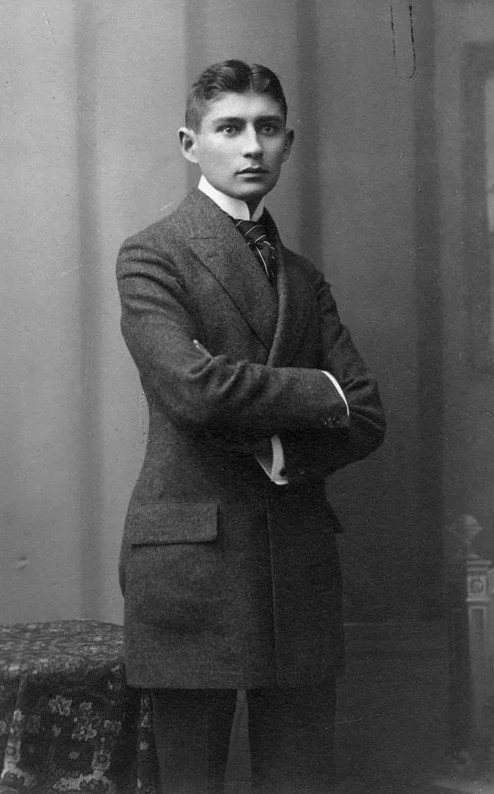
Kafka as a Doctor of Law, around 1906.
I was able to see an original print of this graduation photo alongside Kafka’s hand written journals at the Morgan Library last year. I was, of course, elated.
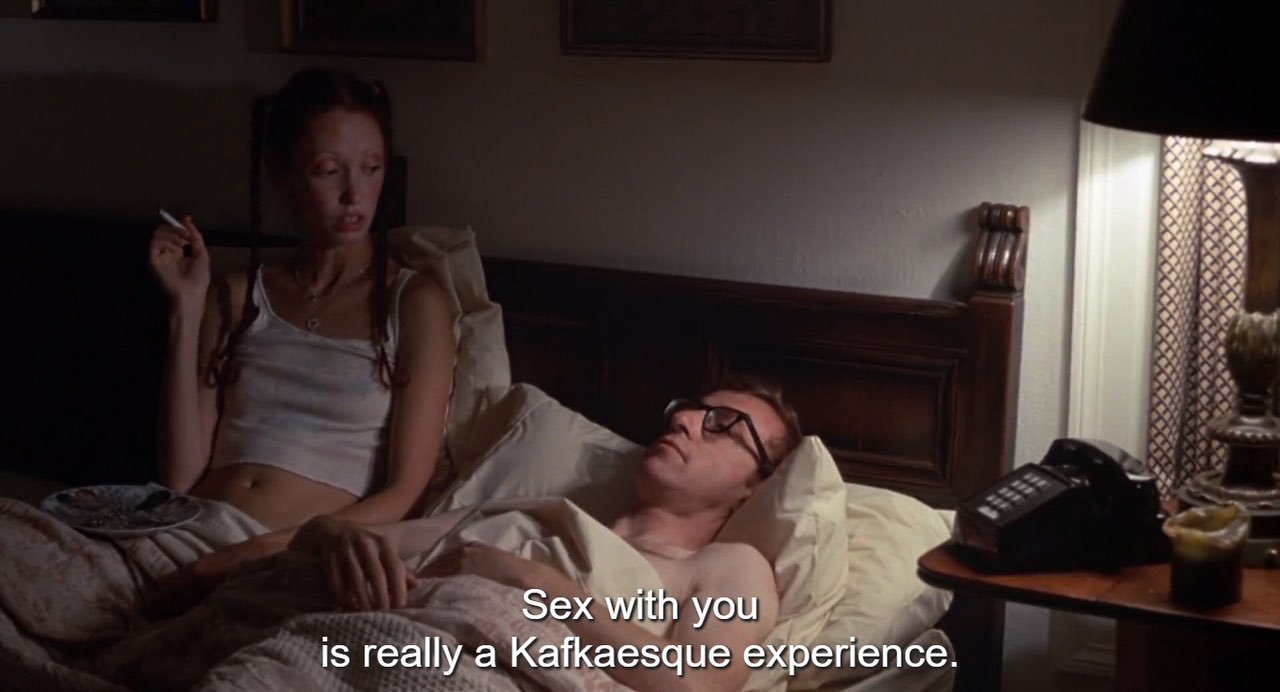
Annie Hall Film Still (1977)