Performing the Law
The Stylistic Foundations of the Kafkaesque
Ellen Courtney
(Originally written as a paper for a Harvard course)
Introduction
My love of classical theater developed in parallel with my immersion in the legal system, an arena for which I initially felt decades of disdain. Like Kafka, I was largely unaware of the influence law was exerting on my intellectual and personal development. I began my career in the classical performing arts and, almost inadvertently, found my way into law firms. It was only when I began researching Kafka as an adult (after reading his collection of letters and becoming deeply absorbed in The Trial ) that something clicked: what had long seemed like two polar opposites were, in fact, deeply intertwined, not only within myself but within the structure of human society. With that a switch flipped and I realized a system which I thought of prior with dread, was actually one of my great passions, I’d simply not fully understood it.
***
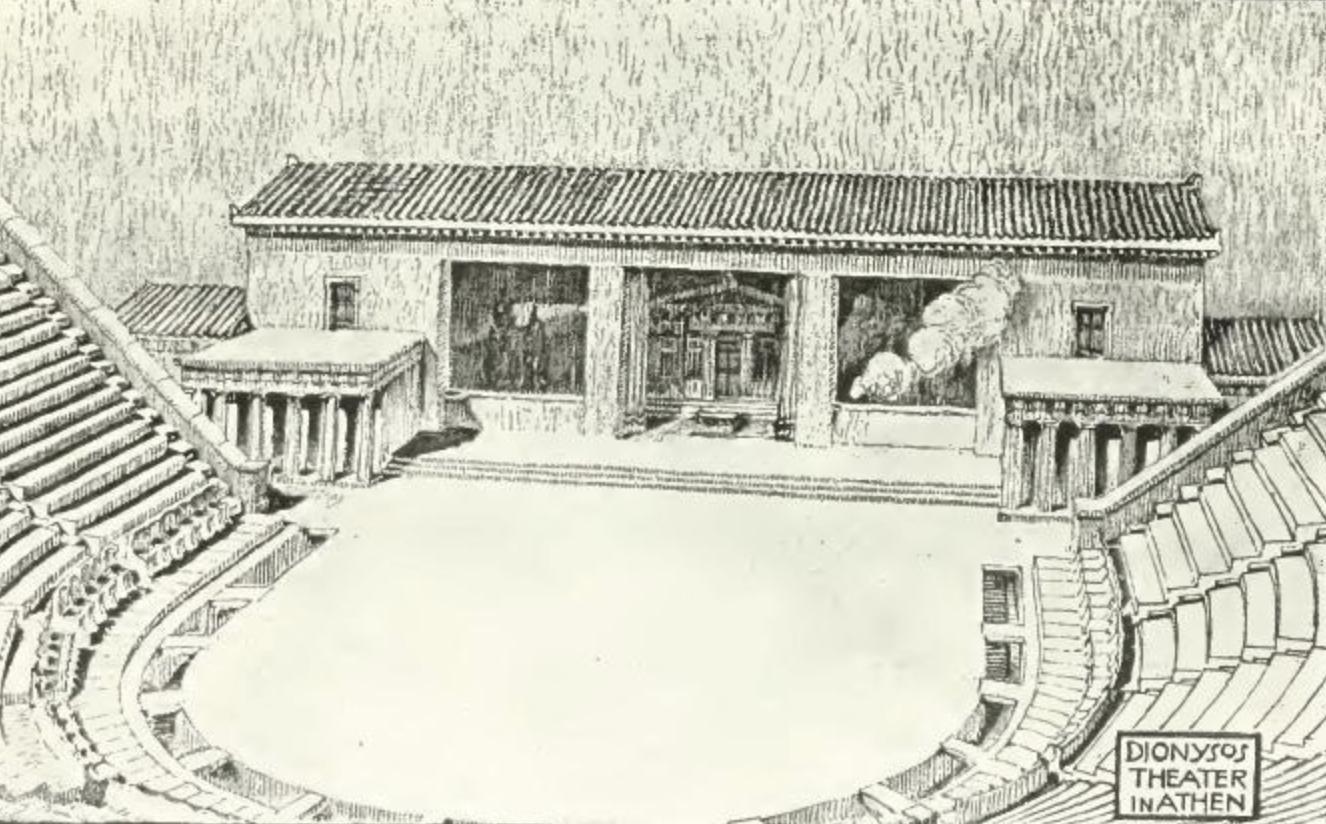
Law and theater were born together on the stage of the Theater of Dionysus. Neither gave rise to the other; they emerged in a process of mutual formation and co-evolution.
Early juridical practices, public arbitration and collective witnessing, provided the cultural framework from which theatrical forms first emerged, embedding performance within the earliest modes of adjudication. Conversely, once tragedy developed into a formal dramatic genre, it began to shape the conceptual vocabulary of the courts: both theater and law organize human conflict into ordered sequences of revelation, contestation, and resolution. Within tragic drama, characters are placed in situations that require the articulation of motives, and their outcomes unfold through controlled speech and procedural constraints. These are methods that echo and refine juridical reasoning. Through such a practice, the tragic stage becomes an early forum in which actions are examined, competing narratives are weighed, and private suffering is made publicly intelligible. In the Theater of Dionysus this happened in anticipation of the courtroom’s own transformation of witnessed deliberation. By acting out the practices of evidence, interpretation, and reasoning, staged tragedy offered a performative template through which legal concepts were not only represented but actively developed. (Goldhill, 23-26)
The most profound example is Aeschylus’s Oresteia trilogy, culminating in The Eumenides (458 BCE). This play literally stages the transition from the law of blood-vengeance to the law of the state. When the Furies (representing irrational retribution) pursue Orestes, the goddess Athena intervenes and establishes the court of the Areopagus on the stage itself. The play thus acts as a founding legislative document in dramatic form, visually demonstrating how divine authority is transformed into civic statute and due process (Goldhill, 49-52).
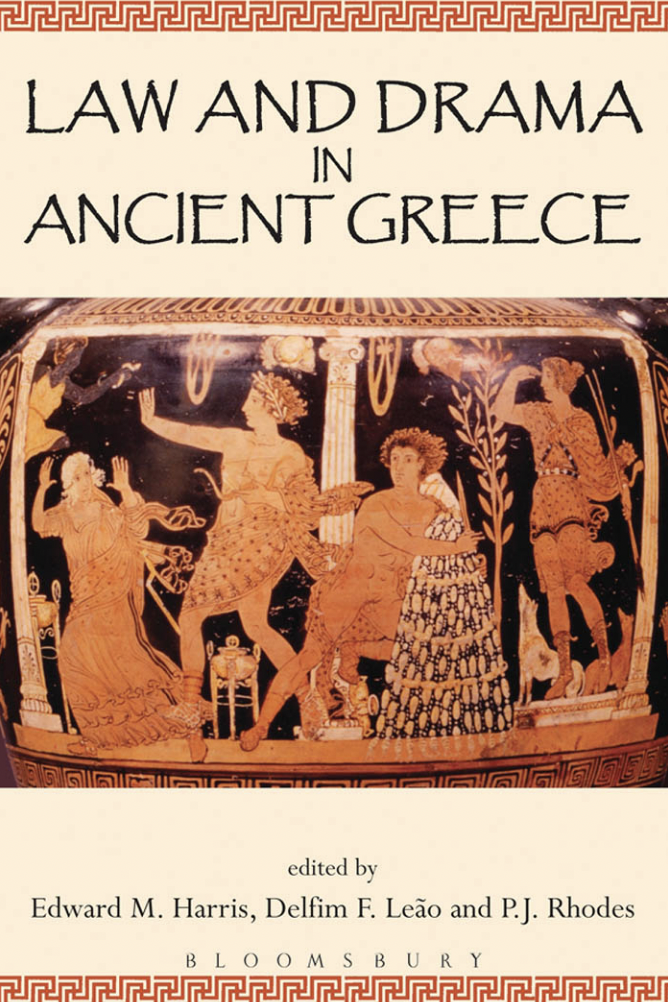
The power to shape meaning, central to both justice and drama, emerged from this shared cultural practice, where the tragic chorus functioned as an early jury, weighing evidence and articulating communal distress (Harris, Leão, and Rhodes, 25 - 27). This classical link suggests that the system of justice is inherently a performance reliant on theatrical persuasion and staging. This concept finds its philosophical expression in the pre-Socratic thought of Heraclitus, who argued that ‘all laws of men are nourished by one law, the law of the gods; for it has as much power as it wishes and is sufficient for all and prevails’ ( Kirk & Raven, 114 Diels & Kranz). This premise suggests that human statute draws its ultimate power from an inaccessible, supreme, and mythic source. This directly foreshadows the, at times, harrowing, mutually divine and absurd, legal systems Kafka would later depict.
***
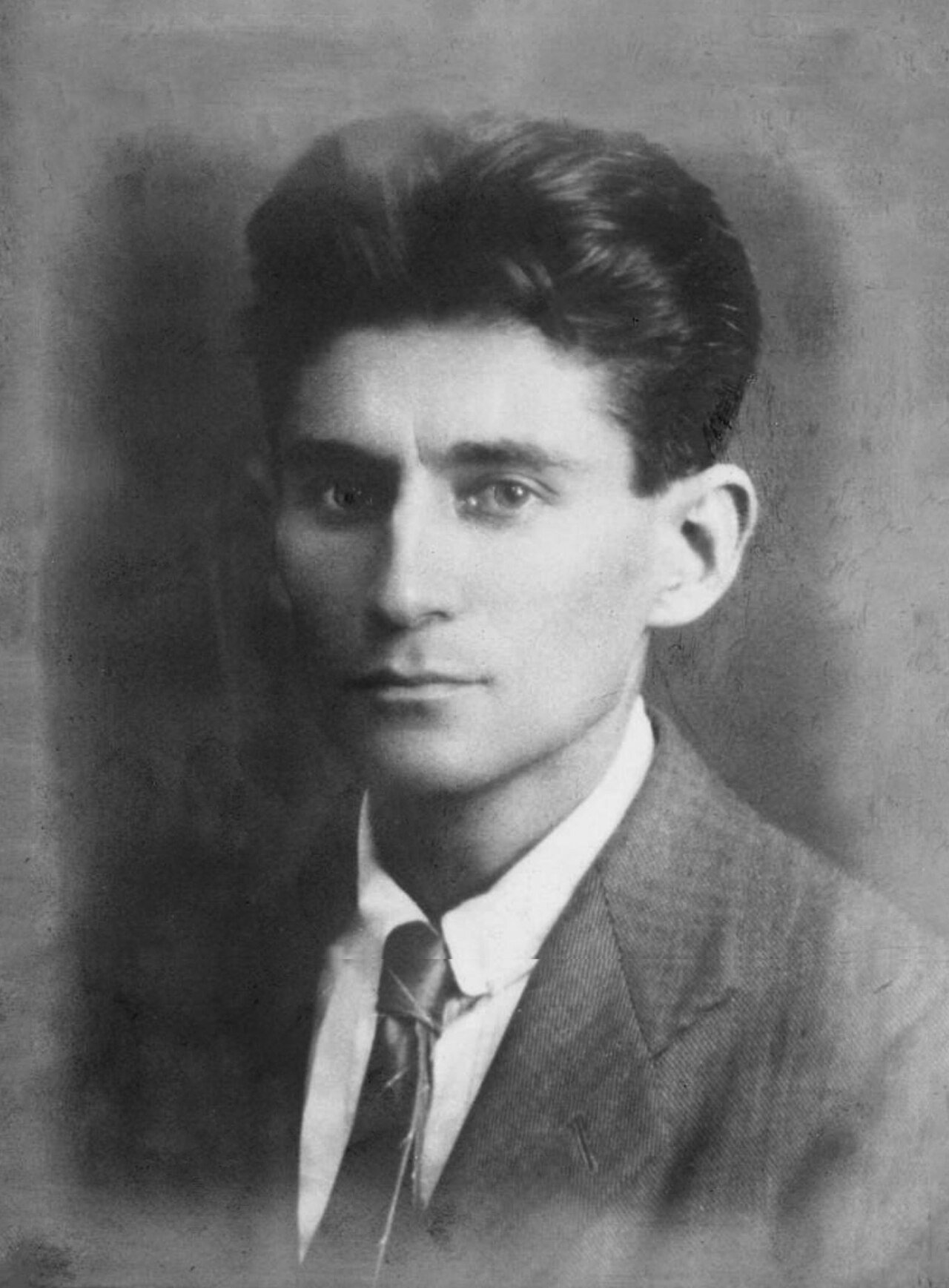
Franz Kafka was born on July 3, 1883, in Prague. He was Czech-Jewish by heritage and Austro-Hungarian by nationality, raised in a German-speaking, middle-class mercantile family. His father, Hermann Kafka, was a domineering, self-made businessman whose forceful personality ruled over the household, while his mother, Julie, offered a gentler, more intellectual presence as she helped run the family enterprise.
From early on, Kafka’s identity was fractured by his position as a German-speaking Jew within the shifting political landscape of the Austro-Hungarian Empire. The period was marked by intensifying Czech nationalism, competing claims over linguistic and civic authority, and entrenched antisemitism that cut across both German and Czech communities. Jews in Prague occupied a liminal position. He was legally emancipated yet socially marginalized, culturally aligned with German institutions yet increasingly viewed as outsiders by German nationalists, and largely excluded from Czech efforts to construct a unified national culture. This unstable political environment produced a persistent sense of doubleness and displacement for Kafka, shaping his early consciousness of being “out of place” in multiple directions at once. These external pressures were compounded by the authoritarian presence of his father, whose pragmatic, commercial worldview functioned for Kafka as a personal embodiment of Law. Confronted with this rigid paternal authority within an already polarized society, Kafka’s more introspective and imaginative disposition found itself in continual conflict with the normative structures surrounding him. (Pawl, 54, 99,149)
As a child, Kafka was physically frail and prone to anxiety, perpetually overshadowed by his father’s robust, domineering presence. Even his name reflects this tension: Kafka derives from the Czech word for jackdaw (kavka), a small, intelligent black bird in the crow family. His anxious inner life became a kind of forced “adaptation” rooted in fear, an idea he later explored in his Letter to His Father. "Dearest Father, You asked me recently why I maintain that I am afraid of you. As usual, I did not know how to reply, partly for the very reason that I am afraid of you, and partly because the grounds for my fear comprise such a great number of details that I could not adequately marshal them in conversation. And if I tried to answer you in writing, my answer would be a letter of inordinate length." (Kafka, Letter to His Father, p 1). For the anxious, overshadowed Kafka, the Father was the first, unappealable court of justice.
His escapes from such oppression were entirely within the realm of performance and narrative. His early fascination with puppet theater was critical. He remembered puppet shows as formative experiences in how narrative and performance create authority, noting that he was fascinated by the "unseen manipulators" giving life to figures on a stage (Brod 39). This established a deep psychic connection between the stage and manipulation, a profound pre-figuring of the vast, unseen machinery of the state bureaucracy he would later encounter. This intense, early draw to performance contrasts sharply with the demands of his adult life.
Kafka's enrollment in the Faculty of Law at Charles University in 1901 was undertaken out of obligation to his father rather than personal interest. His intensive five-year program immersed him in the rigid proceduralism of the Austro-Hungarian state. Kafka’s Prague was marked by the tension between the centralizing, German-speaking bureaucracy of Vienna and the diverse, increasingly nationalist populations of the Empire, particularly the Czech majority. (Stach, 42-45)
As such, Kafka's legal education was rooted in the nineteenth-century German legal tradition, especially Pandectism; the systematic reconstruction of Roman law (Poliak, 447-449). As a result, he studied Roman law, the Austrian civil code, and criminal law, absorbing the rigid procedural logic characteristic of statutory systems (Banakar, 466–490). This training reinforced the principle that justice resided not in ethical reasoning but in the precise application of legal rules. The distinction between moral judgment and procedural correctness, central to his later literary imagination, was foundational to his legal perceptions. His study of the code instilled a view of legal formalism in which procedure and statute operated as ends in themselves, detached from fairness.
The curriculum emphasized procedure and jurisdiction above all. Law appeared as a labyrinth of correct formatting, deadlines, and institutional hierarchies; cases could be won or lost not on their substantive merits but through technical errors in filing or jurisdiction. This produced a legal environment in which the process itself often functioned as a form of punishment. As a result, his resulting legal fiction is not the work of a common civilian railing against law, but of an insider who masterfully weaponizes its own logic and form.
Following his graduation in 1906, his professional life became the true vessel of the "Kafkaesque." After brief court clerkships, he took a permanent position in 1908 at the Workers’ Accident Insurance Institute for the Kingdom of Bohemia. This job was not merely desk work; it was administrative but profoundly juridical. Kafka’s duty was to interpret complex, often contradictory legal statutes to classify risk, prepare case reports, and determine compensation for injured workers (Pawel, 187). This required him to translate individual human suffering into economic and legal calculations. The impersonality of this administrative necessity, reducing a man’s injury and pain to a routine formula, was the specific system that defined a feeling of existential dread.
Driven above all else to write, Kafka structured his life around work and writing in a grueling schedule. He performed his duties at the Workers' Accident Insurance Institute by day, and in the evenings, however, he was entirely devoted to literary production. He would often write late into the night, sometimes until dawn. This constant sacrifice of sleep led to physical exhaustion and shaped his perception of his own existence. Kafka documented this grueling routine in his diary, noting his hostility, saying, “My job is unbearable to me because it conflicts with my only desire and my only calling, which is literature. Since I am nothing but literature and can and want to be nothing else, my job will never take possession of me; it may, however, shatter me completely, and this is by no means a remote possibility.”
His commitment to writing deepened under the strain of his despised day job, culminating in the creation of his breakthrough work, “The Judgment.”
"The Judgment" (Das Urteil), written in a single night on September 22, 1912, is a direct inversion of his legal training. It is a judgment, without any procedure. In it, the father, embodying a supreme, arbitrary authority, delivers a dramatic, unappealable sentence: “I sentence you now to death by drowning!” (Kafka, Complete Stories, 88).
The father’s body, described as tall and commanding, acts as a literal warning finger, representing the physical manifestation of the Law, blending paternal confinement enforced by juridical authority. Then, in 1914, “Vor dem Gesetz” or “Before the Law” was written and first published in 1915 as an independent parable.
In “Before The Law”, the man from the country approaching the gate embodies the paradox of legal modernity: access to the law is theoretically universal, yet in practice, it is indefinitely deferred by institutional authority. The story ends by puzzling the reader as Kafka writes, “No one else could ever be admitted here, since this gate was intended only for you. I am now going to shut it.” The repetitive nature of the dialogue, combined with the requests and denials, mirrors the circular logic of the appeals process and the essential non-linear progression of litigation, leaving the petitioner exhausted by redundant absurdity.
“The Judgement” and “Before The Law” laid the important groundwork for one of Kafka’s most well-known and important works: The Trial (Der Process). Begun in August 1914 and finished in 1915, it is Kafka's ultimate synthesis of law and performance. The plot’s immediate catalyst is personal, yet framed in unmistakably legal terms.
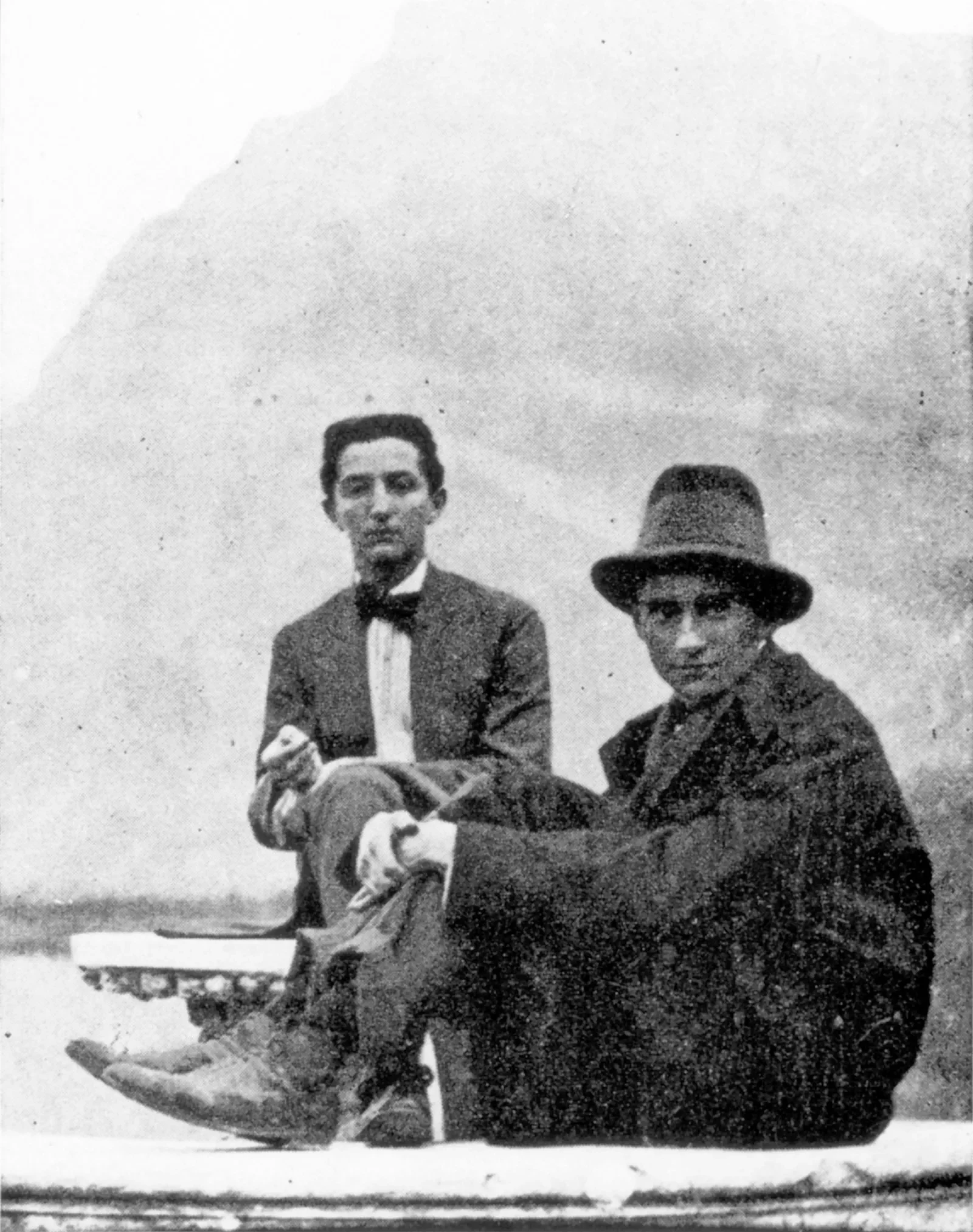
The maddening sense of mercurial disorder that followed his final, painful break with Felice Bauer (whom he met at Max Brod’s home in 1912) unfolded in a hotel room he explicitly event in July 1914 at the Askanischer Hof hotel in Berlin where Franz Kafka's fiancée, Felice Bauer, her sister Erna, and their friend Grete Bloch confronted him about his selfish treatment of Felice, leading to the dissolution of their engagement. Kafka famously described this intense meeting in his diary on July 23, 1914, as a "tribunal," in his diary: “The Tribunal in the hotel… It was a court of justice.”
His relationship with Felice, like many of his relationships with women, was marked by distance and ambivalence, long stretches of longing interrupted by sudden retreat. Kafka feared intimacy as much as he desired it, and this tension made even private life feel like a proceeding in which he was always being judged. This experience reinforced for Kafka the idea that private life could also take the shape of litigation.
The Trial is structured not as a realist narrative, but as a series of procedural hearings. The plot's circularity mirrors the logic of the institutional appeals system Kafka knew from his work. The novel depicts the protagonist, Josef K., as constantly seeking access to the Law only to be led back to the starting point. The system is defined by procedural opacity; there is no indictment, no clarity, and no resolution. This paradoxical structure is summarized by the Priest in the Cathedral chapter, who delivers the parable borrowed from Kafka’s earlier work, "Before the Law": “The right understanding of a matter and a misunderstanding of the same matter do not wholly exclude each other” (Kafka, The Trial, 240). This line, which captures the collapse of the law into a self-justifying riddle, is among the clearest definitions from the story of the stylistic term “Kafkaesque.”
The atmospheric aesthetic of this anxious and confused nightmare Kafka routinely produces is directly influenced by his draw to theater. The power of this connection was intensified after Kafka saw Yitzhak Löwy's Yiddish acting troupe perform in Prague in 1911 at the Café Savoy. (Carpenter). He was drawn to the troupe's presence and the non-Western theatrical style, which blurred the lines between actor and audience (Gilman, 31-35). This influence is evident in The Trial, as Kafka imports the exaggerated and grotesque into his legal world. Characters like the whipping warders, the lecherous judges, and the overly dramatic lawyers are not realistic psychological portraits, but grotesque characters whose theatrical actions define their authority. Their behavior, shouting, posturing, leering, or administering corporal punishment on demand, is a theatrical caricature of power, not a rational element of real-world due process. Kafka’s figures are less civil servants and more stylized juxtaposing expressions, similar to characters from Expressionist drama or the commedia dell'arte.
The courtrooms in The Trial are often housed in dusty attics, lacking the sense of an official order of the court. Josef K.'s first hearing is conducted in a crowded, suffocating assembly where the "audience" presses in on him. This staging replicates the physical immediacy and chaos of the Yiddish stage, transforming the judicial process into a macabre, claustrophobic performance. The crowd's reaction, their inexplicable laughter, or sudden silence, functions as a chorus, but one that is indifferent or hostile, amplifying Josef K.'s sense of perplexity and isolation rather than ordered reason and justice.
The theatricality of Kafka’s work extends beyond character action to the scene itself. Scholars have long argued that Kafka’s settings resemble symbolic stage-scapes more than realist environments. Walter Benjamin, in his crucial essay from 1934 “Franz Kafka: On the Tenth Anniversary of His Death,” observes that Kafka’s works are structured like stage plays, each scene bearing the clarity and symbolic weight of a set (Benjamin, Illuminations, 134).
The set Kafka built through his writing was often stark and minimal. In his diary, he notes the allure and mystery of sparse settings, writing, “The sight of the simple stage, which awaits the actors as silently as we do. Since with its walls, the chair and the table it will have to suffice for all events, we expect nothing from it, rather await the actors with all our strength and are therefore unresistingly attracted by the singing behind the bare walls, which introduces the performance.” (Kafka The Diaries, p 35).
This economy of the setting becomes a structural principle in his writing about law: the more minimal the space, the more intensely the reader feels the pressure of unseen authority. The scenes at times read like notes for set direction: “It consisted of a long corridor from which roughly made doors led out to the separate departments of the attic. There was no direct source of light but it was not entirely dark as many of the departments, instead of solid walls, had just wooden bars reaching up to the ceiling to separate them from the corridor. The light made its way in through them, and it was also possible to see individual officials through them as they sat writing at their desks... ” (Kafka, The Trial, 42)
Sparse environments, bare rooms, empty corridors, and makeshift courtrooms create stages on which legal power appears dream-like, and overdetermined. In this way, the minimalist theatrical aesthetic becomes inseparable from Kafka’s depiction of law as an abstract, omnipresent force enacted through gesture, stage direction, and performance rather than transparent procedure.
One of the most powerful and persistent stage elements found in Kafka's work is light, or the absence of it. Light functions not merely as illumination, but as a juridical force. For instance, in the interrogation rooms of The Trial, the light is consistently described as dim, yellowish, or suffocatingly enclosed, marking the ominous transition from ordinary civic life to the domain of accusation and guilt. Crucially, at "The Gate" in the parable "Before the Law," a powerful radiance shines from within the gateway, yet remains physically unreachable, echoing traditional religious iconography. Light, in these instances, symbolizes inaccessible truth, sought-after knowledge, or a transcendent, divine Law that the petitioner can never enter. The entire legal system, therefore, operates as a performance where the setting itself is dim, or oppressive, or distantly aglo, just as the confines, and openings of justice. And though Kafka wrote many characters, when the light did shine, it was on him.
From an early age, Kafka developed a mode of understanding and surviving the world by imaginatively restructuring it into a kind of drama in which he occupied both the position of director and that of the principal actor. His emotional life assumed a dramaturgical character: experiences were not merely endured but staged internally, shaped by an acute self-awareness and a tendency toward theatrical interpretation. Kafka did not simply draw upon theater and myth as external influences; rather, he moved through his environment as if it were already organized according to their logics, perceiving events as scenes and himself as their central performer.
This dynamic is evident in all of Kafka’s writing, but blatantly clear in figures such as Josef K. in The Trial and the country man in “Before the Law,” whose fraught encounters with authority reproduce Kafka’s own patterns of self-interrogation. These protagonists operate as internal doubles through whom Kafka portrays, with dramatic precision, the crises of agency and judgment that shaped his inner life. In this way, he fashioned a literary and psychological framework in which authorship allowed him to script and inhabit the very mythological dramatic dilemmas he sought to comprehend.
Kafka drew upon mythic judgement as external influences; but he equally moved through his environment as if it were already organized according to the logic of an actors scene-work, perceiving himself as every story’s central, actor. In this way, he fashioned a literary and psychological framework in which authorship and embodiment were intertwined, allowing him to script and inhabit the very crises he sought to comprehend.
This reliance on dramatic staging and player portrayal of his inner scenes, reveals a core understanding within Kafka's writing: that law and drama are inextricably linked through their long established interconnectedness. And in the same way, the physical setting of the court is itself a mythological space. Kafka’s later works, such as "The Silence of the Sirens" (1917) and "Prometheus" (1918), both written after The Trial, demonstrate this view of myth as an ancient legal code, a form of the oldest and strongest authority that has prevailed precisely because of its foundational, dramatic power to persuade.
An example of this interpretive power can be found in “The Silence of the Sirens,” wherein he reimagines the Homeric scene as a study of interpretive error. In Kafka’s telling, Odysseus survives not through cleverness but through a misunderstanding of the Sirens’ silence. He writes, “Now the Sirens have a still more fatal weapon than their song, namely their silence. And though admittedly such a thing never happened, it is still conceivable that someone might possibly have escaped from their singing; but from their silence, certainly never” (Kafka, “Silence of the Sirens”). The Sirens, the supreme temptresses, represent an ultimate, non-negotiable Law; by choosing silence, they become an enigma. The story reveals how legal subjects often misread the very forces that judge them. Odysseus’s failure to recognize their greater threat is the silence which mirrors the predicament of Josef K., who spends all his effort trying to interpret the indecipherable code of the Court, thereby sealing his own fate through a kind of self-willed entanglement with legal procedure.
Further, “Prometheus,” with its four contradictory versions of the titan’s fate, shows how law derives its power from repetition, ritual, and interpretive instability, each version functioning like a competing legal precedent that reinforces the authority of the myth. Kafka writes that “the legend tried to explain the inexplicable,” and that even when it “began with a kind of truth,” it inevitably “had to end in the inexplicable.” One version has the birds grow tired; another has the wound heal. Yet the story persists, and Prometheus remains bound.
This literary strategy exposes how myth operates as a juridical system, endlessly subject to reinterpretation. The power of the Law lies not in a single, fixed truth but in the multiplicity of evolving narratives that together confirm the authority of the system itself. The persistence of the myth becomes the persistence of versioned justice. In this way, Kafka’s structure mirrors how case law functions: precedent gains force through accumulated, sometimes contradictory rulings that reinforce the legitimacy of the legal order, regardless. As in the myth, the law is sustained not by absolute truth but by continual reinterpretation over time.
Contemporary Law, however, as depicted in The Trial, offers none of the narrative or moral justice of ancient tragedy. It is a stressful, procedural performance that denies the protagonist an understanding of his crime and an opportunity for a final, cathartic judgment. The "Kafkaesque" style is thus the literary result of applying the precise, cold language of legal statutes (learned in his training) to a world governed by the chaotic, arbitrary staging of the theater.
When considering the premise that law was born of theatre, that the earliest forms of communal judgment and codified authority emerged from staged, ritualistic performances, utilizing costumes, roles, and dramatic presentation, then Kafka's profound engagement with legal systems can be re-read through that same dramatic lens. Despite his apparent repulsion and frustration with the legal labyrinth, his entire literary career can be seen as an unconscious, deeply felt love for the structure of dramatic enactment. This staging is not a casual observation; it is an obsession seen in everything from his numerous diaries and letters to his short stories and novels. Through this, he grants the legal system the full weight of theatrical importance. Thus, even as Kafka registers a seemingly intellectual and emotional hatred for the structured system of the Law, his unceasing literary preoccupation with its subject and form, even as dramatic, performance, suggests an unknowing, inescapable passion for the original, theatrical genesis of all authority; law.
As such, the law preserves mythic judgment while operating as a fluctuating character throughout Kafka’s life and work. What emerges is a writer deeply attuned to the fact that juridical power depends as much on its modes of presentation, its choreography, secrecy, and ritual, as on its statutes, and that these dramatic features shape the subject’s experience of being judged. Its opaque procedures are funneled through an endless bureaucratic psychological maze and deliberately staged before the audience of a watchful jury.
In the end, it is the powerful influence of Law, acting upon the stage of Dionysus, which ultimately determines its own singular literary expression: Kafkaesque.
Works Cited
Banakar, Reza. “In Search of Heimat: A Note on Franz Kafka’s Concept of Law.” Law & Literature, vol. 22, no. 3, 2010.
Benjamin, Walter. Illuminations. Edited by Hannah Arendt, translated by Harry Zohn, Schocken Books, 1968.
Carpenter, Aaron. “How Franz Kafka Connected with Yiddish Language and Theater in Prague.” Stroum Center for Jewish Studies, University of Washington, 3 Mar. 2023, jewishstudies.washington.edu/arts-culture/how-franz-kafka-connected-with-yiddish-language-and-theater-in-prague/.
Gilman, Sander L. Franz Kafka, The Jewish Patient. Routledge, 2003.
Goldhill, Simon. Reading Greek Tragedy. Cambridge University Press, 1986.
Harris, Edward M., Delfim F. Leão, and P.J. Rhodes, editors. Law and Drama in Ancient Greece. Bloomsbury Academic, 2013.
Kafka, Franz. The Complete Stories. Edited by Nahum N. Glatzer, Schocken Books, 1971.
Kafka, Franz. The Diaries of Franz Kafka, 1910–1923. Edited by Max Brod, translated by Joseph Kresh, Schocken Books, 1948.
Kafka, Franz. Letter to His Father. Translated by Ernst Kaiser and Eithne Wilkins, Schocken Books, 1966.
Kafka, Franz. Letters to Felice. Edited by Erich Heller and Jürgen Born, translated by James Stern and Elisabeth Duckworth, Schocken Books, 1973.
Kafka, Franz. The Trial. Translated by Breon Mitchell, Schocken Books, 1998.
Kirk, G. S., and J. E. Raven. The Presocratic Philosophers. Cambridge University Press, 1957.
Pawel, Ernst. The Nightmare of Reason: A Life of Franz Kafka. Vintage Books, 1984.
Poliak, G. A. “The Law of Kafka: Pandectism, Legal Fictions, and Literary Modernism.” Law and Literature, vol. 24, no. 3, 2012.
Stach, Reiner. Kafka: The Decisive Years. Translated by Shelley Frisch, Princeton University Press, 2013.