War In Gen Beta
The launch of war in Iran today marks the deployment of fully functional, advanced AI technologies in combat, at a scale and level of integration not previously seen. As demand accelerates rapid technological evolution, the concept of “threat” begins to take on a new form. In a landscape where computational power, semiconductor access, AI training models, satellite networks, and cyber capabilities shape global influence, advanced technology can be as consequential as traditional missiles. The diffusion of AI-enabled systems across allied networks and rival states raises urgent strategic questions about escalation, deterrence, and technological parity in the emerging Gen Beta era.
2025 marked the dawn of Generation Beta, a term coined by social researcher and futurist Mark McCrindle to describe the cohort born from 2025 onward, following Generation Alpha. McCrindle uses generational demography to track how technological and social shifts shape each new cohort. While Alpha was the algorythm build via social media, Beta represents the first generation born into a fully immersed AI world; from personal devices, to the workplace, to education, to war.
It is arguable that the forefront of AI-enabled defense analytics in the United States is Palantir Technologies, founded in 2003 and active in defense AI deployment for over a decade. Backed early by venture capital including Peter Thiel through Founders Fund, Palantir built software platforms such as Gotham and Foundry that are used by U.S. defense and intelligence agencies for battlefield intelligence integration, predictive logistics, and operational planning.
Within the area of warfare, Palantir has developed AI-driven data fusion platforms that integrate satellite imagery, drone feeds, signals intelligence, and real-time battlefield reporting to assist commanders in decision-making. In recent years, the company has publicly demonstrated its Artificial Intelligence Platform, which allows military operators to task autonomous systems, analyze drone surveillance, and simulate battlefield scenarios. The electronic warfare systems including truck-mounted signal jammers capable of disrupting communications across large geographic areas , are also part of modern military arsenals globally.
Confirmed today was the US’s first-ever use of the LUCAS drone for autonomous AI-enabled swarm tactics. // Meanwhile China has supplied advanced long-range, anti-stealth radar systems to Iran, who also moved to Chinese encryption systems.
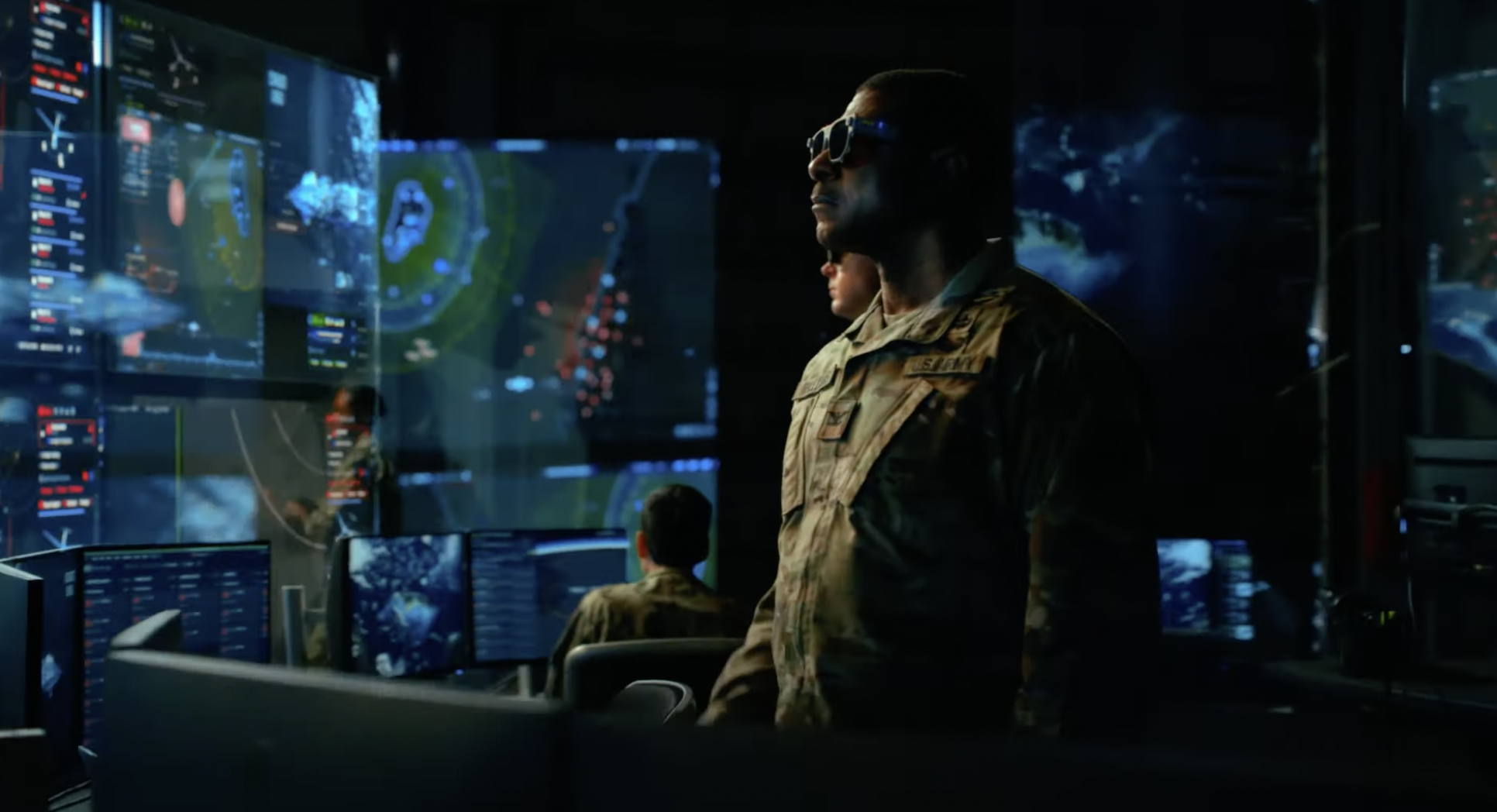
Palantir has partnered with major U.S. defense contractors including Raytheon Technologies, and L3Harris Technologies, integrating AI-driven data platforms into aerospace, intelligence, and battlefield systems. I’m completely fascinated by Palantir and it’s CEO, Alex Karp, known for his eccentric behaviors, wild rationalizations of some pretty nefarious goals, sword collection, and love of tai chi. - Just last year, Palantir released a video which looked more like a sophisticated ad for a sleek video game , than an ad for war. But that is the reality. Not only are we seeing new tech in the tactile sense, we are being transported into an abstract “other” plane. I think back to a lecture I heard on simulation theory at The Harvard Club…
Since tensions escalated in the Middle East over the past year, including heightened friction between Iran and Western allies, analysts have noted that modern warfare increasingly involves technological capability alongside conventional force. Most recently reported was Iran’s use of Chinese AI-assisted surveillance systems. In the Gen Beta era, this tech also includes algorithmic intelligence analysis, predictive targeting models, electronic signal disruption, and information operations conducted through digital networks. The playing field has expanded beyond traditional conflict into domains of code, data, and electromagnetic control.
With the United States currently maintaining leadership in advanced AI research and semiconductor design, new initiatives to accelerate frontier technologies, including expanded quantum computing research by firms such as IBM , aim to maintain strategic advantage. One huge initiative to propell the aforementioned forward is The Genesis Mission (which had a supremely produced PR video).
Meanwhile, China has made significant advancements in AI-enabled robotics, autonomous drone swarms, hypersonic weapons research, quantum communications, advanced surveillance infrastructure, and military-civil fusion programs under its national AI strategy launched in 2017.
This matters geopolitically because China has deepened strategic ties with Iran, including economic agreements and reported technology cooperation in telecommunications and surveillance infrastructure. At the same time, Iran and Russia have expanded military coordination, having a televised sit down just last week. Their joint ventures include drone technology exchanges. The growing strategic alignment between China, Russia, and Iran, reflects increasing coordination in defense, energy, and technology sectors.
Meanwhile, Israel and the United States are now operating in deep strategic alignment and leveraging a structural technological advantage across AI on the battlefield. Joint initiatives such as U.S.-funded Iron Dome systems, Department of Defense AI contracts, and expanding cyber cooperation represent embedded defense infrastructure rather than symbolic partnerships. Federal investment through the CHIPS and Science Act, alongside Israel’s among-the-highest per-capita R&D spending globally, reinforces this edge, while companies like Palantir play a central role in integrating intelligence and operational data across U.S., Israeli, and (as of late last year) UK public-sector systems, signaling a broader AI-driven alliance architecture.
Yet this dominance is not guaranteed: some say China now rivals or surpasses the United States in AI patent filings, quantum research output, and state-backed biotech expansion. As quantum computing advances from show-y experimentation toward applied encryption, decryption, and materials science breakthroughs, the strategic balance may depend less on software leadership alone and more on semiconductor supply chains, compute infrastructure, and control over critical data ecosystems. This raises the question not of whether the U.S. will still lead the race against China tomorrow, what role the defense investment in India will play, and how long any lead can be structurally sustained until the intro of fully integrated bio tech at scale (Gen Gamma) c. 2035/40.